cross-posted from: https://lemmy.zip/post/59925291
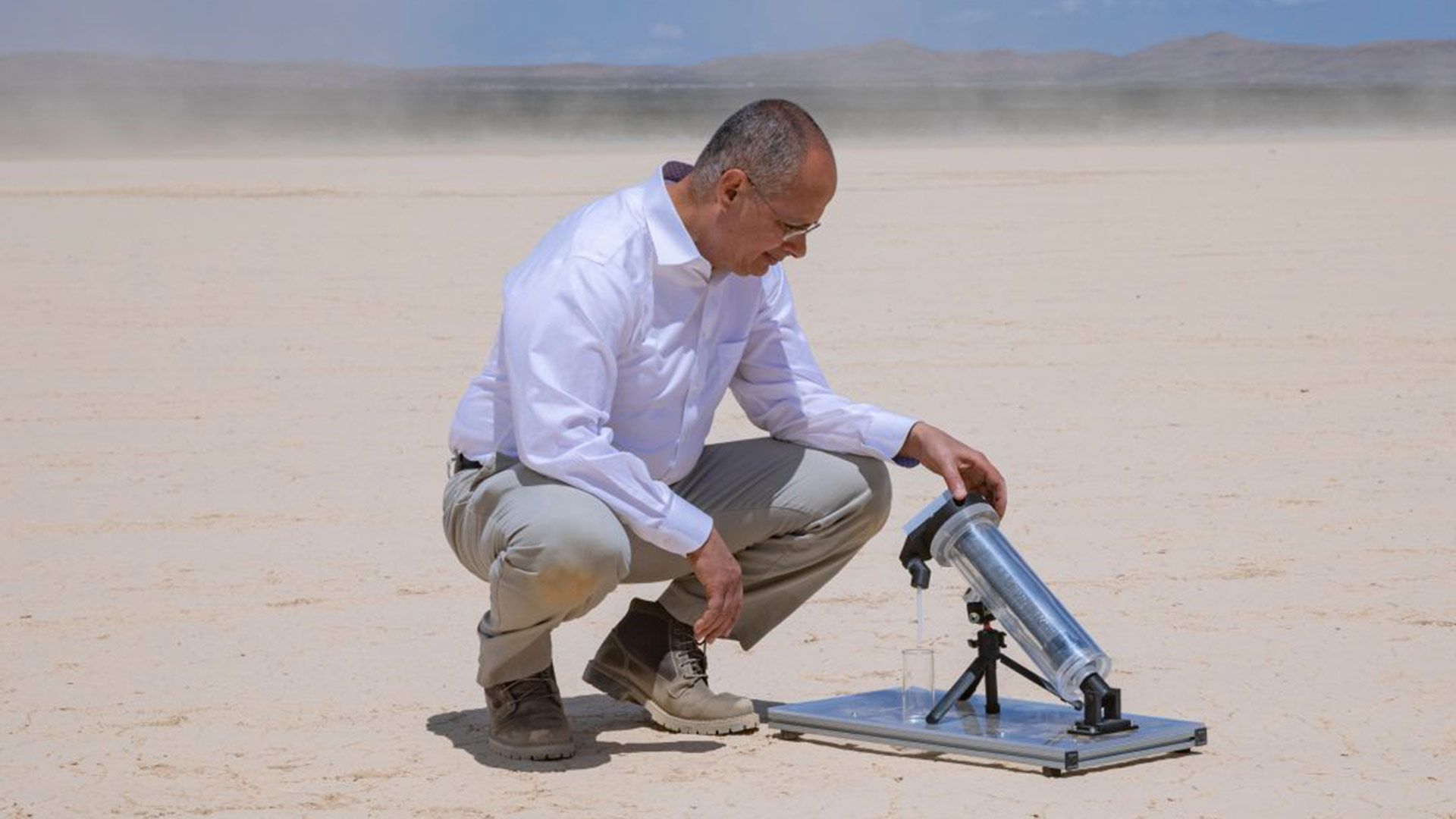
The system can function in air with 20% humidity or less. But these 1,000 liter a day machines are not small, at around shipping container size.
Don’t let Sam Altman know about this, his data centers about to have some upgrades /s
Dewcatchers, dewcatchers everywhere…
Well, unless he sells the patent to Nestle, it’s COMMUNISM. Water is private property. /s
It’s a dehumidifier. There’s nothing to patent that hasn’t already been patented.
I used to work for a company making a similar device, the chemistry behind the technology is actually a well researched topic, and there are many kinds of various chemistries that can achieve a similar effect. Silica gel packets are the most common, a cheap solution that extracts moisture from the air, but is non-reusable.
These MOF compounds are useful because they have a fundamentally different method of collecting the water molecules. The framework traps the molecules inside, which can be later released with heat. Thermal solar power is free, but does require careful management of the rest of the device such that the material can get hot enough (usually around 100c), which also providing another surface to condense the vapour. I spent alot of time designing and testing such panels. They do work! I can post pictures of fishtanks of water later.
There truly couldn’t be much of a downside to these technologies. The real alternative is desalination, which produces hyper concentrated salt pools, or well water extraction, which is also bad…
The reason these technologies is usually due to the cost effectiveness to produce the material, and to build the enclosure around the material. The panels have to scale very large to get any reasonable about of solar power, plus the condensing and collecting mechanisms also add weight and cost. Water is not an expensive product, so at the end of the day, the economics don’t always work out favourably.
Happy to answer any questions about the technology.
Here’s a picture of one of our tests generating water from air! We got 21kg from a large-ish panel.

I can’t show much else but I can guarantee we did harvest the water from the air.
At mass scale, could taking enough moisture out of the air affect local weather patterns?
Technically yes! To put it in perspective, there’s about 2.5kg of water in the atmosphere per m^2 of earth surface area. If you put enough panels across the earth, you could probably do a decent job at taking some of the water out of the air.
We have to look at another factor affecting the water in the air. As we take water out of the air, it’s not really a finite resource. Most water in the air generally comes from the sun evaporating the oceans. If we take the water out of the air, the sun will put the water back. There’s always a balance of humidity and quantity evaporated. When the humidity is lower, the sun would have an easier time evaporating more water due to the osmosis of the water from the source (ocean) going into the air. Osmosis is a kind of log graph, so even if the humidity is lower, the exponential tail means the solar evaporation and humidity pretty much balances out at the end of the day.
It’s similar thing to taking water from a river. If we take all the water from a river, can we dry up downstream? Yes! But considering the height of the atmosphere, it’s like standing at the edge of the river trying with a bucket and trying to scoop everything up. Unless these water-from-air harvesters can reach all the way to the clouds, we probably won’t dry anything up.
Not that I think your device has the same danger because water captured from the air will likely quickly be released again into the same air, but I think this is not a very good example of the safety of your device:
It’s similar thing to taking water from a river. If we take all the water from a river, can we dry up downstream? Yes!
We can and we do. The Colorado and the Yellow river no longer consistently reach the ocean.
Well… There would also have to be water to actually collect from the air. Thunderfoot made a really good video about these dehumidifiers when yet another one popped up on Kickstarter claiming to end water shortages.
You’re absolutely correct that there has to be water in the air. However part of the trick to these panels is that they’re not steady state. They have a day cycle and a night cycle. During the night is where they do most of the work of absorbing the water from the air. Over a number of cycles I have overseen, the humidity in the air rises dramatically during the night. This helps these panels in terms of air extraction, since they work on a humidity basis, rather than a total-air-water-content. Think dilution or osmosis when it comes to the actual absorbtion mechanism.
When you do the math, it also doesn’t really seem like there’s alot of water in the air. Only something like 10-40 grams of water, especially depending on the outdoor temperature. We ran indoor tests with a panel a few sqm in size, and even in a small indoor warehouse, it was not able to dehumidify the warehouse to any significant levels. Maybe at most 5% humidity delta. However air is not static, and wind is always blowing, even when it seems really weak. There’s a huge amount of atmosphere above the ground, and unless the panels can absorb the water from the clouds too, the localized de-humidification that happens isn’t going to be significant. It’s like trying to suck up all water on a beach. The waves are going to replace it shortly enough.
So the one practical limit of these panels that is most frequently missed is the solar aspect. The MOF materials are like a sponge. You can absorb all the water in the air, but you still need to take the water of the MOF. The limit depends on the sensible and latent heat of the water, while in the sponge. MOF doesn’t actually really change the boiling point of water at all, so you’re really essentially creating a water distillation tower. In 1sqm of land, the most irradiance you’re going to get is about 1kw/sqm. 1kwh can boil about 10 liters of water. Taking that into account, over a 8 hour solar day. That means at most a single square meter of solar panel could generate 80 liters of water per day. It’s alot, but considering solar losses, glass loss, and thermal loss, more practical limits would probably be like 40 liters. The MOF material also required sensible heat as well, so already a huge portion of incoming solar energy is gone to heating the environment and raising temperature.
In all, you’d have to cover a huge amount of acres before this would dent the atmosphere in terms of humidity. The 1000 liters a day can really only happen when you have a large solar collection area, plus absorbtion surface area to back it up.
There truly couldn’t be much of a downside to these technologies.
What you mean to say is “We don’t know what the downside will be untill these technologies are implemented and used for a long time and then studied.” Otherwise you sound like the well-intentioned-but-unhinged chemist that accidentally starts the zombie apocalypse at the beginning of the movie.
There’s two impacts these panels could have. There’s the solar irradiation aspect, and the air humidity aspect of them.
In the solar irradiance balance, you have a net energy in, most of which goes directly to heating the ground. A panel would aim to absorb as much as that energy as you can, most of which would go towards a phase change of the material to release the water bonds. MOFs are extremely clean in terms of their re-usability, and don’t release any other compounds into the steam when released. Think of it like a condensation system, but without having to collect any water from any ground based source.
The air humidity is the other balance. In theory you could “absorb all the water out of the air”. In most business cases, these need to be deployed to more coastal regions, not literally smack in the middle of the desert. But in such cases, the atmosphere is highly dynamic and more or less equalizes total air water content in a certain microclimate. It makes it very renewable since the sun evaporates massive amounts of water from water bodies, which can be returned via either rain, or through water harvested through water-from-air chemistry.
The industry will want to buy water regardless of where they are, so when evaluating technologies, these provide much lower impact to the environment than any existing groundwater based system.
What is the current and mass scale potential price for this? Hundreds or thousands of dollars?
MOFs and other types of materials are actually a highly well researched topic. They’ve been around for decades! However in the current state of things, it’s kinda like battery technologies we see. It depends on the scale of manufacturing that these researchers can scale up production to.
Alot of time, the processes researchers do to manufacture small batches to produce a small prototype don’t work well when scaling up. The team I was working with had lots of trouble with it, but eventually settled into producing batches that would fill approximately a construction bucket worth at a time. Not a huge amount, but definitely a starting spot. It not mpossible to assembly line something like a millions of buckets a day, but at the same time your manufacturing costs go up alot.
There are many different competing kinds of water-from-air materials. These researchers use MOFs, but since they use metals, the cost to manufacture goes up significantly. Polymer based materials are a bit more “secret sauce” depending on the formulation, but they’re simpler in the sense you can use specific kinds of salts. The cost difference is something like 10x, so MOF really needs to produce 10x more value, otherwise it’s not worth it.
Since water is such a commoditized product, commercial prices are somewhere around a few dollars per cubic meter of water. When you design something that has to compete with existing products, you have to have a cost at, or less than existing prices. Either your panel has to be super cheap, or your water production has to be off the charts.
Let’s say a commercial water-from-air solar farm lasts for 30 years. Each day, 1sqm of panel produces 1 cubic meter of water. You’re only selling that water for $3 (approximate commercial rates). Over the lifetime of the panel, your income is 30years * $3 = $32850. It’s a big number! A realistic current figure for water production at best would hit 0.01 cubic meters of water. Holey cow! Now you’re actually making 1% of our original target, which is 3 cents per day, or $330 over it’s lifetime.
Selling anything that’s 1m^2 for only that price point is a crazy feat to achieve. I designed a number of systems that would try to enable that, but you must also factor in everything including installation and maintenance costs.
There’s billions of dollars thrown around to invest in these technologies. The only thing stopping it are the unit economics. You have to compete in an industry that is centuries old. But these can succeed, they can easily replace every single water filter in the world.
Thanks! Very cool tech
Happy to help! It is really a cool technology, but with alot of nuances. It certainly can do what they claim, but for now only in controlled environments. I got pretty close to testing a real cost effective solution, but I couldn’t see it through due to extraneous circumstances.
This could be interesting for a mars settlement.
One problem maybe kinda hypothetically down. Ten thousand more to go.
More of the same huh? Heres how it goes in 6 steps:
1 Draft marketing plan 2 go public w/some shares for sale 3 Announce prototype and launch marketing strategy (ie plaster Nobel laureates name all over the product and drop adds on social media) 4 drive market value up 5 sell shares and get rich 6 you’ve sold out and gotten rich, company dissolves because it was all a hype machine. (Not a real solution machine, or it’d have sold those real solution machines instead of purchasing ad space.)
Replace w crypto currency if u wish. Same lies.
So… Another dehumidifier… We’ve been over this before.
Many times.
Many many times.
It’s wild that people keep falling for this same scam.
Hardly a scam. There’s nothing to insert money into.
This is just empty hype
You don’t think they’re going to try to sell these? You’re falling for the scam already.
The scam where I buy a shipping container at some point?
The one where you are scientifically illiterate and can’t spot a scam to stop it and possibly allow public funds to it. So, yeah maybe you will be chipping in for that shipping container.
you are scientifically illiterate
Because I’m not buying an overpriced humidifier?
So you do know is a scam… Geez what was the point of all that? Thanks for wasting my time.
It really is. I’ve seen at least a handful of these on Kickstarter before, and before Kickstarter was a thing I’m pretty sure I saw something about “revolutionary new technology” like this in a TV documentary.
I wonder if these guys realize that if you suck up all moisture from the air, it will be pretty dry and you will need the same amount of water to replace the water you displaced
I am guessing they are aware how their machine works. Air isn’t usually stagnant, if you have moving air that means moisture is replacing it.
I’m just saying it’s way too energy intensive and not even worth it. You’re using this thing in a dry environment. I mean maybe you run this on solar energy and just have crazy amounts of electricity, maybe it’s worth it.
If people keep reinventing the fucking dehumidifier I’m going to start beating these dipshits bloody. Or maybe I should just collect the old beater ones I see at estate and yard sales to make YouTube videos making fun of them. Regardless this is barely worth praise for an amateur engineering project let alone a nobel prize.
deleted by creator
Where’s my noble peace prize for blowing up kids in an Iranian school? 🫲🍊🫱
I’m always extremely skeptical of stuff like this
As you should be
Until the device is deployed in at least a few real live locations
How many times do we have to fall for this garbage. Well I guess if your doing it to scam dumb rich people be my guest, but this shit is dumb.
Oh no, the same scam again, when will people realize that putting dehumidifiers in the desert, where there is little to none humidity in the air does not produce significant quantities of water.
You can claim that your solution produces thousands of liters of water, but in practice its obvious that you cannot extract more water than what’s already im the air, once you extract it, there is nothing left, it may work at first, but is not going to work continuously forever.
This is another example of a promised technology scam, pay me for the development and once it doesn’t work, disappear with the money. People keep falling for it for some reason.
I wpnder how this will impact the environment.
It would be cheeper and easier and less energy intensive to load a truck up with water and drive it to where you need it.