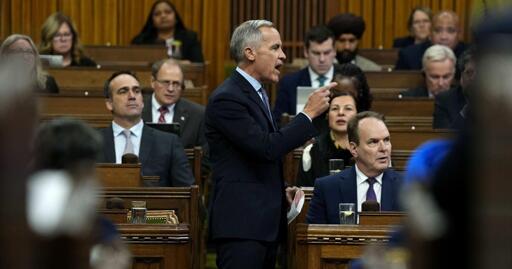
“Hidden in the federal government’s 634-page omnibus bill C-15, the Budget Implementation Act, is a measure that has so far escaped scrutiny. Under the pretext of regulatory efficiency, Prime Minister Mark Carney plans to grant cabinet ministers the power to exempt any individual or company from any federal law on the books — except for the Criminal Code — for up to six years.”

  • Typhoon@lemmy.ca
    link
    fedilink
    arrow-up
    19
    ·
    edit-2
    4 days ago

    Here’s the relevant part of the bill copied below, and the link to the bill on parl.ca. Scroll down a little bit to section 208. There are some things I trimmed out for brevity. This is not the whole thing, just the parts I considered most relevant.


    208 Section 11 of the Act and the heading before it are replaced by the following:

    #Exemptions to Encourage Innovation, Competitiveness or Economic Growth

    Order
    12 (1) Subject to subsections (3) and (7), a minister may, by order, for a specified validity period of not more than three years and on any terms that the minister considers appropriate, exempt an entity from the application of

    • (a) a provision of an Act of Parliament, except the Criminal Code, if the minister is responsible for the Act;
    • (b) a provision of an instrument made under an Act of Parliament, except an instrument made under the Criminal Code, if
      • (i) the minister is responsible for the Act, or
      • (ii) the body that made the instrument is accountable, through the minister, to Parliament for the conduct of its affairs; or
    • (c) a provision of an Act of Parliament, except the Criminal Code, or a provision of an instrument made under an Act of Parliament, except an instrument made under the Criminal Code, if the minister administers or enforces the provision.

    Conditions
    (3) A minister may make an order under subsection (1) only if the minister is of the opinion that

    • (a) the exemption is in the public interest;
    • (b) the exemption would enable the testing of, among other things, a product, service, process, procedure or regulatory measure with the aim of facilitating the design, modification or administration of a regulatory regime to encourage innovation, competitiveness or economic growth;
    • (c) the benefits associated with the exemption outweigh the risks;
    • (d) sufficient resources exist, and appropriate measures will be taken, to maintain oversight of the testing, manage any risks associated with the exemption and protect public health and safety and the environment; and
    • (e) a feasible implementation plan has been developed.

    #Transparency and Parliamentary Oversight

    Accessibility
    14 (1) Subject to subsections (2) and (3), a minister must, as soon as feasible after making an order under section 12, make the order and the following information publicly accessible:

    • (a) a description of the decision-making process and a summary of the reasons for the order; and
    • (b) a description of the process for providing comments or information to, or requesting information from, the minister in relation to the order.

    Exception

    • (2) The minister may exclude information that, in the minister’s opinion, would be inappropriate to make publicly accessible for reasons that include safety or security considerations or the protection of confidential or personal information.
    • AGM@lemmy.ca
      link
      fedilink
      arrow-up
      16
      ·
      4 days ago

      The section on oversight is also critical. It basically gives the Minister the power to decide for themselves what information should not be made public as part of oversight, which is as good as saying there is no real oversight authority.

    • patatas@sh.itjust.worksOP
      link
      fedilink
      arrow-up
      12
      ·
      4 days ago

      The AI industry in Canada has been pushing to essentially ‘self-regulate’, and (at least in this layperson’s opinion) seems like the legislative method for giving them what they want.