

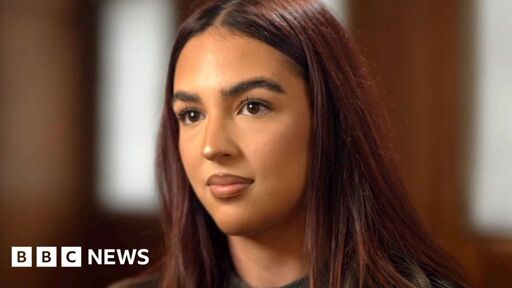
Dilara was on her lunch break in the London store where she works when a tall man walked up to her and said: “I swear red hair means you’ve just been heartbroken.”
The man continued the conversation as they both got in a lift, and he asked Dilara for her phone number.
What Dilara did not realise was that the man was secretly filming her on his smart glasses - which look like normal eyewear but have a tiny camera which can record video.
The footage was then posted to TikTok, where it received 1.3m views. “I just wanted to cry,” Dilara, 21, told the BBC.
The man who filmed her, it turned out, had posted dozens of secretly filmed videos to TikTok, giving men tips on how to approach women.
Dilara also found out that her phone number was visible in the video. She then faced a wave of messages and calls.
Yes, and covert recording by definition is done without the knowledge or consent of the one being recorded. It should be illegal everywhere, but some states have single-party consent laws which allow it.
(imagine applying such a rule to sexual activity, it would be absurd; yet somehow it’s totally legal to broadcast a person’s name, face, and location to the world without them even knowing what’s happening?)
I think knowledge and consent need to be distinguished, there are lots of people who are filmed in public that wouldn’t consent to it, bike thieves for instance. I don’t think that banning filming or photography in public is a sensible idea.
Do you also support CCTV and flock cameras, then? Because that’s the same argument used to justify those.
“Be afraid of crime. Let the authorities spy on you. Now you’re protected.” What about when the authorities abuse their power? Who’s going to protect you then?
(For the record, I believe all public officials should be required to give up some of their expectations of privacy as a condition of working as a public official. The public requires a level of trust in them that it doesn’t require of ordinary private citizens. They should have to submit financial statements, and they should also have to declare unconditional consent to be recorded by anyone in any given moment, except in confidential spaces like homes, offices, briefing rooms, etc.)
But the thing is, in order to catch a bike thief on video, you have to already be recording either them or the bike, and since it’s nearly impossible to predict, the chances of catching it on camera are slim. Unless you use ubiquitous area cameras pointed at all the bike racks. And even then, if they’re casual enough or hide their face then no one would know they’re stealing it except the owner of the bike, or no one would be able to identify the person who stole it.
I don’t think giving the authorities (or the hive mind, for that matter) unrestricted access to constant recordings of every public space is a sensible idea, because it’s too prone to abuse. That’s how you get a surveillance state, like the USSR or america right now. They misinterpret a movement of your hand and label you “antifa terrorist” and you get flagged for closer scrutiny, where everything they observe you doing is then run through interpretive filters that are biased towards describing you as a terrorist.
Whoever is analyzing those recordings is going to be paranoid to some degree, or their algorithms are going to hallucinate patterns that aren’t there, or someone is going to get vindictive and use the power to abuse anyone they don’t like. Do you want every twitch, gesture, or facial expression being labelled and categorized by AI and then saved into a profile of you that some unknown spook can access at any time? Then when you notice plain clothes agents scoping you out, they get a screenshot of your face looking nervous and label it as “definitely guilty,” and they close in on you tighter and tighter until either your anxiety takes over and you’re labeled as paranoid/psychotic, or they push you into a panic attack and label your conduct “disorderly” and use it as a pretext to make an arrest?
The whole thing is too prone to abuse, and it’s not even an effective deterrent for crime prevention. I can’t agree with it. Better to build community trust and economic empowerment to address crime from the root causes; that’s the only method that’s been shown to significantly reduce crime.